



Introduction: Rethinking Mental Illness and Recovery
Mental illness is often framed as something permanent—a lifelong condition to be managed rather than overcome. Diagnoses such as depression, anxiety disorders, and trauma-related conditions are frequently associated with long-term treatment, ongoing symptoms, and recurring challenges. While this perspective reflects part of reality, it is incomplete.
Advances in neuroscience over the past few decades have fundamentally changed how we understand the brain. One of the most important discoveries is that the brain is not static or fixed after childhood. Instead, it is dynamic, adaptable, and constantly reshaping itself in response to experiences, thoughts, and behaviors.
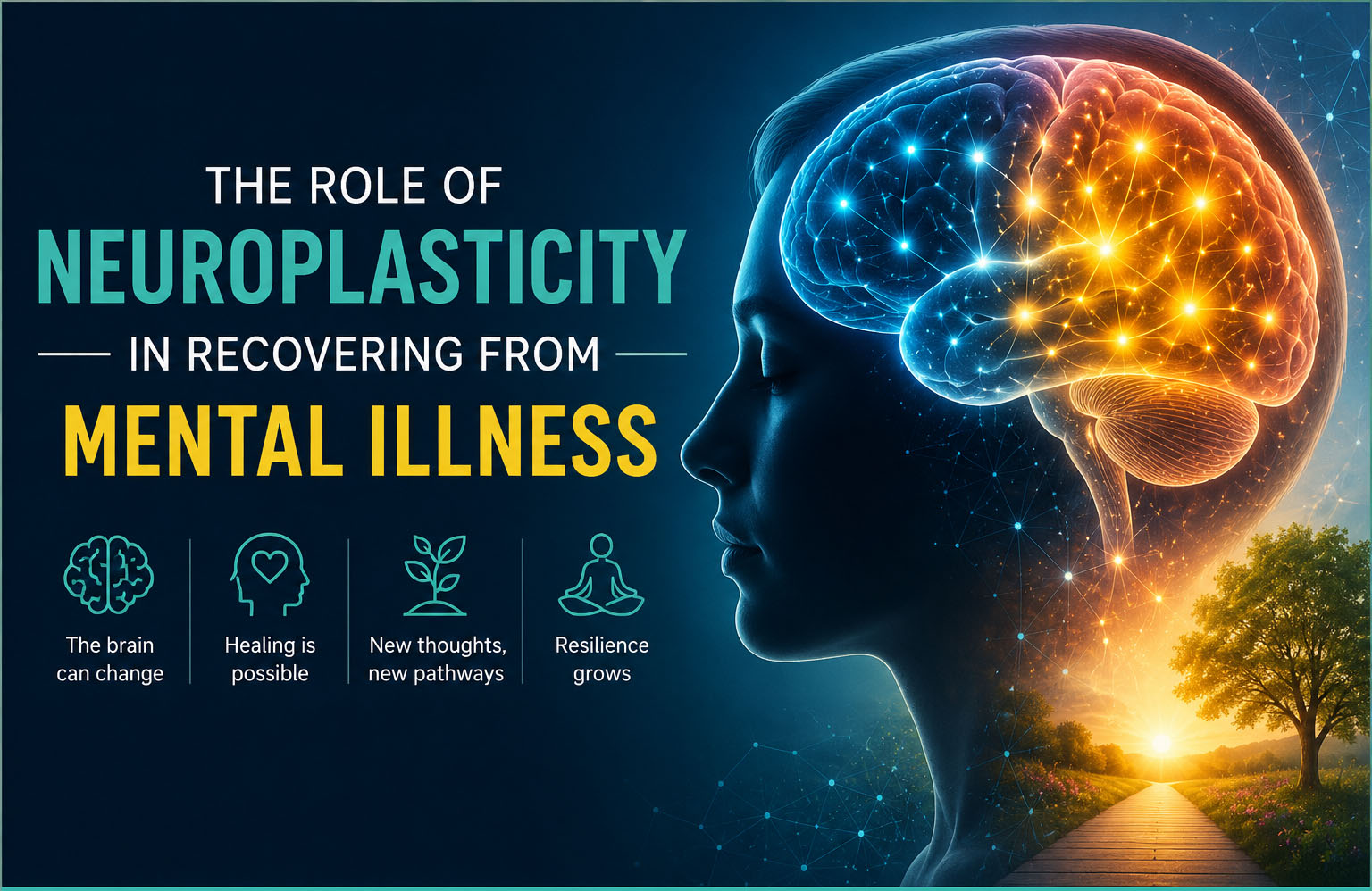
This ability is known as neuroplasticity, and it provides a powerful framework for understanding recovery from mental illness. Rather than seeing mental health conditions as permanent states, neuroplasticity shows that the brain can develop new pathways, weaken harmful patterns, and strengthen healthier ways of functioning.
This does not mean recovery is quick or easy. But it does mean that change is biologically possible—and that hope is grounded in science.
What Is Neuroplasticity?
Neuroplasticity refers to the brain’s ability to reorganize itself by forming new neural connections throughout life. Every experience we have—whether it is a thought, emotion, or action—activates specific neural circuits. When these circuits are used repeatedly, they become stronger and more efficient.
This process is often summarized as:
“Neurons that fire together, wire together.”
In practical terms, this means:
- Repeated thoughts strengthen certain mental patterns
- Behaviors reinforce neural pathways
- Experiences physically reshape the brain
For example, if someone frequently engages in negative self-talk, the neural pathways associated with those thoughts become stronger over time. Conversely, practicing positive or balanced thinking can gradually strengthen alternative pathways.
Neuroplasticity operates in two key ways:
- Structural plasticity: Changes in the brain’s physical structure, including the formation of new connections
- Functional plasticity: The brain’s ability to shift functions from one area to another
These processes occur continuously, meaning the brain is always adapting—whether we are aware of it or not.
How Mental Illness Develops in the Brain
Mental health conditions are not solely psychological—they also involve measurable changes in brain function and structure. Over time, repeated exposure to stress, trauma, or negative thought patterns can shape neural pathways in ways that reinforce distress.
For example:
- Depression is associated with reduced activity in areas related to motivation and reward, making it harder to experience pleasure or engage in daily activities
- Anxiety disorders involve heightened activity in the amygdala, the brain’s fear center, leading to increased sensitivity to perceived threats
- Trauma-related conditions can over-activate the brain’s threat detection system, keeping individuals in a constant state of hypervigilance
These patterns are not simply “in the mind”—they are encoded in neural circuits. Over time, they become automatic, shaping how individuals perceive and respond to the world.
This is why mental illness can feel persistent and difficult to change. The brain has effectively learned these patterns through repetition.
However, the same principle that allows these patterns to form also allows them to be changed. Neuroplasticity means that harmful pathways can be weakened, and healthier ones can be strengthened.
Neuroplasticity and the Science of Recovery
Recovery from mental illness involves more than reducing symptoms—it involves changing how the brain functions. Neuroplasticity provides the mechanism for this change.
When individuals engage in therapeutic practices, adopt healthier behaviors, or experience supportive environments, they are not just “coping.” They are actively reshaping their neural pathways.
This process allows for:
- Reduced intensity of negative emotional responses
- Improved emotional regulation
- Greater resilience to stress
- More balanced cognitive patterns
Importantly, neuroplasticity is experience-dependent. This means that change occurs through repeated, consistent experiences over time. One-off efforts are unlikely to create lasting change, but sustained practice can lead to significant transformation.
Evidence-Based Interventions That Harness Neuroplasticity
1. Psychological Therapies
Therapies such as Cognitive Behavioral Therapy (CBT) are designed to identify and modify unhelpful thought patterns. By challenging negative beliefs and replacing them with more balanced perspectives, individuals gradually weaken maladaptive neural pathways.
Over time, these new patterns become more automatic, demonstrating how therapy directly engages neuroplastic processes.
2. Mindfulness and Meditation
Mindfulness practices involve paying attention to the present moment without judgment. Research shows that regular mindfulness practice can lead to measurable changes in the brain, including reduced activity in stress-related regions and increased connectivity in areas associated with emotional regulation.
This helps individuals respond to challenges more calmly and effectively.
3. Physical Activity
Exercise plays a critical role in promoting neuroplasticity. It stimulates the release of brain-derived neurotrophic factor (BDNF), a protein that supports the growth and survival of neurons.
Regular physical activity has been shown to improve mood, reduce anxiety, and enhance cognitive function—all of which are linked to changes in brain structure and function.
4. Social Connection
Human relationships are essential for mental health. Positive social interactions help regulate the nervous system and reinforce healthy emotional patterns.
Supportive environments provide the repeated experiences needed to strengthen neural pathways associated with safety, trust, and connection.
Learn more about social media addiction →
5. Workplace Mental Health Interventions
In many cases, mental health challenges are influenced by workplace environments. Chronic stress, high workloads, and exposure to trauma can reinforce harmful neural patterns over time.
Structured workplace interventions—such as resilience training, psychological safety initiatives, and trauma-informed practices—can help interrupt these patterns and support healthier brain functioning.
Prevent burnout →
What is vicarious trauma →
Why Neuroplasticity Requires Time and Consistency
One of the most important aspects of neuroplasticity is that it is gradual. The brain changes through repetition, not instant transformation.
This is why quick fixes rarely lead to lasting results. Sustainable change requires:
- Consistent practice of new behaviors
- Repeated exposure to positive experiences
- Ongoing reinforcement of healthier patterns
Initially, new behaviors may feel uncomfortable or unnatural. This is because existing neural pathways are stronger and more established. However, with continued effort, new pathways can become dominant.
This process is similar to building a muscle—the more it is used, the stronger it becomes.
Practical Strategies to Support Neuroplasticity
Individuals can actively support their brain’s ability to change by incorporating the following strategies into their daily lives:
- Establish routines: Consistent sleep, nutrition, and daily structure support brain health
- Challenge negative thinking: Actively question and reframe unhelpful thoughts
- Engage in therapy or training: Structured interventions provide guidance and reinforcement
- Build supportive relationships: Social connection strengthens positive neural pathways
- Reduce chronic stress: Managing stress prevents reinforcement of harmful patterns
- Practice mindfulness: Enhances awareness and emotional regulation
Even small changes, when practiced consistently, can lead to meaningful improvements over time.
Shifting the Narrative Around Mental Illness
Understanding neuroplasticity challenges many common misconceptions about mental health. It shifts the focus from permanence to possibility, from limitation to potential.
Instead of asking, “What is wrong with me?” individuals can begin to ask:
“What patterns has my brain learned—and how can I reshape them?”
This perspective does not minimize the challenges of mental illness. Rather, it provides a more accurate and empowering understanding of how change occurs.
Conclusion
Neuroplasticity offers one of the most hopeful and scientifically grounded perspectives in mental health. It demonstrates that the brain is not fixed, and that recovery is not only possible but supported by biological processes.
While change requires time, effort, and the right support, the capacity for transformation exists in every individual.
Recovery is not about erasing the past—it is about rewiring the future.
