
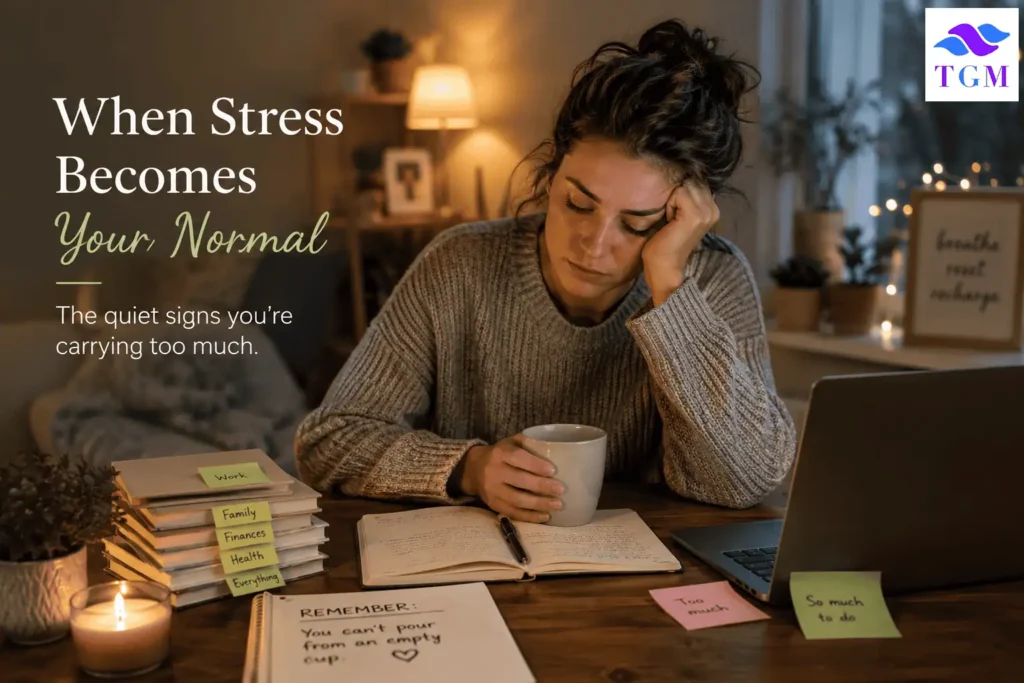
There is a strange moment that can happen after a particularly stressful period.
You finally get a quiet evening. Nothing needs your immediate attention. Your phone is silent. There is nowhere you need to be.
So why can’t you relax?
Your body is sitting on the couch, but your mind is still moving.
You think about the conversation you had earlier. You remember something you forgot to do. You start thinking about tomorrow. Then you remember another problem you have been putting off. Before long, your supposedly quiet evening has become another hour of mentally working through everything that feels unfinished.
You might tell yourself that you’re just tired.
Maybe you’re having a busy week.
Maybe things will settle down soon.
And perhaps they will.
But sometimes “I’m just stressed” gradually becomes the explanation for almost everything.
You’re tired because you’ve been stressed.
You’re impatient because you’ve been stressed.
You can’t concentrate because you’ve been stressed.
You don’t feel like seeing anyone because you’ve been stressed.
You can’t switch off because you’ve been stressed.
Eventually, something else happens.
Stress starts to feel normal.
And that can make it surprisingly difficult to recognize how much you are actually carrying.
Stress Isn’t Always a Dramatic Feeling
When people imagine stress, they often picture an obvious crisis: an overwhelming situation, a major deadline, a frightening event, or a moment when everything seems to fall apart.
Everyday stress can look very different.
Sometimes it is simply the feeling that you are always behind.
You finish one thing and immediately think about the next.
You have free time but feel guilty about using it.
You wake up already thinking about everything you need to accomplish.
You sit down to watch something, but keep checking your phone.
You have a conversation with someone you care about while mentally rehearsing something else.
You go to bed exhausted but find your thoughts becoming more active rather than quieter.
None of these experiences automatically means that something is seriously wrong.
But when they become persistent, they may be telling you something important about the amount of pressure you are carrying.
The National Institute of Mental Health notes that stress can be a normal response to external causes, while anxiety can continue even when there is no immediate threat. Understanding that distinction can be useful when reflecting on your own experience. (nimh.nih.gov)
The point isn’t to label yourself.
It is to become more aware of what your mind and body may be experiencing.
The Moment You Realize You Haven’t Really Relaxed
One of the quieter signs of carrying too much is realizing that your free time doesn’t feel particularly free.
You have an evening without plans, but you spend it thinking about tomorrow.
You take a weekend away, but keep checking messages.
You sit down to read, but your attention keeps returning to the things you haven’t finished.
You go on holiday and need several days before you stop thinking about what is happening at home.
This can happen because the brain does not necessarily switch from “demand mode” to “relaxed mode” simply because the clock says the day is over.
If you’ve spent weeks or months responding to constant demands, uncertainty, or unfinished responsibilities, quiet can initially feel unfamiliar.
You may even mistake relaxation for laziness.
That can create an uncomfortable cycle:
You feel overwhelmed → you try to keep up → you finally get free time → you feel guilty for not being productive → you fill the time with more tasks → you never properly recover.
Eventually, you can become very good at being busy and surprisingly bad at doing nothing.
When Small Things Start Feeling Huge
Another clue can be the way you respond to relatively minor problems.
Someone sends an annoying message.
The internet stops working.
You spill something.
Someone asks you a question when you’re already concentrating.
A plan changes at the last minute.
Normally, these things might barely register.
But when you’re already carrying a lot, the smallest additional demand can feel like the final straw.
You snap.
You become unusually impatient.
You feel like everyone needs something from you.
You want to be left alone.
The reaction may seem disproportionate even to you.
That doesn’t necessarily mean the small event was the real problem.
Sometimes it was simply the last thing added to an already full mental load.
Your Mind May Keep Reopening the Same Problems
Stress has a way of making unfinished business feel particularly loud.
You replay conversations.
You imagine possible outcomes.
You think about what you should have said.
You plan what you’re going to say tomorrow.
You run through everything that could go wrong.
Then, just when you think you’ve finished thinking about it, the same thought comes back.
This kind of mental repetition can be exhausting because it creates the feeling of activity without necessarily creating progress.
There is a difference between thinking about a problem and solving a problem.
Sometimes you are working toward a solution.
Other times, your mind is simply circling the same uncertainty because it hasn’t found a satisfying place to put it.
Recognizing that difference can be useful.
If a problem can be acted upon, you may be able to identify one small next step.
If it cannot be solved right now, repeatedly rehearsing it may only keep your mind activated.
The Body Can Notice Before You Do
Stress is not purely a mental experience.
The body’s stress response involves multiple systems working together to prepare us to respond to demands. When stress becomes persistent, people can notice changes in areas such as sleep, energy, concentration, muscle tension, or general sense of wellbeing.
That doesn’t mean every headache, restless night, or tired morning is caused by stress. Physical and emotional experiences have many possible causes.
But patterns are worth noticing.
Perhaps you’ve been sleeping poorly for several weeks.
Perhaps you feel tense even when nothing particularly difficult is happening.
Perhaps you are exhausted but find it difficult to settle down.
Perhaps concentrating on a simple task feels harder than it used to.
These experiences are not reasons to diagnose yourself.
They are reasons to pay attention.
Sometimes the most useful question isn’t, “What’s wrong with me?”
It is:
“What has my life been asking of me lately?”
The “I’ll Feel Better After This Week” Trap
One of the easiest ways to live with chronic pressure is to keep postponing recovery.
You tell yourself you’ll relax after this deadline.
After the project.
After the move.
After the exams.
After the family event.
After things settle down.
The problem is that life rarely stays settled for very long.
One demanding period is replaced by another.
If recovery is always scheduled for some imaginary future when everything is finally under control, you may never actually get there.
There will always be another email.
Another appointment.
Another responsibility.
Another problem that needs attention.
This doesn’t mean you should ignore important responsibilities.
It means that rest cannot always be treated as the reward you receive after everything else is finished.
Sometimes recovery needs to exist alongside ordinary life.
Why You Can Feel Exhausted and Still Keep Going
Human beings are remarkably adaptable.
We can get used to demanding schedules.
We can get used to sleeping less.
We can get used to constant notifications.
We can get used to saying yes.
We can get used to carrying other people’s expectations.
And because we adapt, we may conclude that everything is fine.
After all, we’re still functioning.
We’re still going to work.
We’re still looking after the family.
We’re still answering messages.
We’re still getting things done.
But functioning and feeling well are not necessarily the same thing.
Someone can continue meeting their responsibilities while feeling increasingly depleted.
That is one reason chronic stress can be difficult to recognize from the outside.
You don’t have to completely fall apart for your current pace of life to deserve a second look.
The High Price of Always Being Available
Smartphones have made it possible to carry a connection to the rest of the world almost everywhere.
That can be wonderful.
It can also make it difficult to establish any genuine psychological distance from other people’s needs.
A notification appears.
You check it.
You don’t need to respond, but now you know about the problem.
Another message arrives.
You check that too.
A news alert appears.
Then a social-media notification.
Then a reminder about tomorrow.
None of these events necessarily takes more than a few seconds.
But each one asks for a little piece of your attention.
Over time, constant availability can make silence feel uncomfortable.
You may find yourself reaching for your phone whenever there is a moment of boredom.
You may struggle to sit through a meal without checking something.
You may feel strangely restless when there are no notifications.
Sometimes the problem isn’t how much time technology takes.
It’s how rarely your attention gets to be completely yours.
Stress Can Change the Way You Relate to People
When you’re carrying too much, relationships can be affected even when the other person has done nothing wrong.
You may have less patience.
You may become quieter.
You may cancel plans because you don’t have the energy to socialize.
You may become irritated by questions that would normally seem harmless.
You may withdraw because being around people feels like another demand.
Sometimes you may even feel guilty about it.
You know you care about the people around you, but you don’t have much emotional space left.
This is another reason stress can become self-reinforcing.
You feel overwhelmed, so you withdraw.
You withdraw, so you have less connection and support.
You feel more alone, which can make everything feel heavier.
That doesn’t mean you need to force yourself to socialize when you genuinely need quiet time.
It means that connection is worth protecting, especially during periods when life feels demanding.
When You Start Saying “This Is Just How I Am Now”
Perhaps one of the most revealing moments is when stress stops being something you are experiencing and starts becoming part of how you describe yourself.
“I’m just an anxious person.”
“I’ve always been a worrier.”
“I don’t sleep well.”
“I’m terrible at switching off.”
“I’m just someone who needs to stay busy.”
“I’m always stressed.”
These statements can feel like simple descriptions.
But sometimes they hide an important question:
Was I always like this, or have I become accustomed to feeling this way?
People change.
Circumstances change.
Responsibilities change.
The amount of pressure in our lives can change.
So can the ways we respond to it.
That doesn’t mean every problem can be solved through willpower or a change in routine. It simply means that it can be useful to question the assumption that the way you feel today is necessarily the way you will always feel.
You Don’t Have to Earn Rest
There is a strange idea that rest must be deserved.
You can relax once you’ve finished everything.
You can take time off once the work is done.
You can have a quiet weekend once you’ve caught up.
You can say no once you’ve helped everyone else.
But the list rarely ends.
There will always be something unfinished.
There will always be another responsibility.
There will always be someone who needs something.
Rest is not evidence that you are unproductive.
It is part of being a person who has finite attention and energy.
That doesn’t mean every moment should be optimized for relaxation either. Sometimes what you need is movement, social connection, creativity, time outdoors, meaningful work, solitude, laughter, or simply doing something that has no productive purpose at all.
The important thing is having some parts of life that are not asking you to perform.
What If You Don’t Know How to Switch Off?
You don’t necessarily need to redesign your entire life.
Sometimes it is worth starting much smaller.
Notice the moments when you feel most mentally crowded.
What usually happens immediately beforehand?
Is it your phone?
A particular person?
A certain time of day?
Unfinished work?
Uncertainty about tomorrow?
Too many decisions?
Once you notice the pattern, experiment with creating a little space around it.
That might mean putting your phone somewhere else for part of the evening.
It might mean writing down tomorrow’s priorities before bed so you don’t have to keep rehearsing them.
It might mean protecting a short period of the day when you are not expected to respond to anyone.
It might mean saying no to something that you would normally accept automatically.
It might mean talking honestly with someone you trust about how much you have been carrying.
The goal isn’t to create a perfect stress-free life.
There isn’t one.
The goal is to create moments in which your mind doesn’t have to solve, respond, anticipate, or perform.
Pay Attention to What Actually Restores You
Not everything that feels like a break is restorative.
Scrolling through hundreds of posts may be a distraction, but it may not leave you feeling refreshed.
Watching television can be relaxing, but sometimes it becomes another way of avoiding the fact that you’re exhausted.
Sleeping in can help, but it may not address everything that has been keeping your mind occupied.
Different people recover in different ways.
For one person, it may be walking alone.
For another, it may be cooking with friends.
Someone else may feel better after exercising, reading, gardening, making music, spending time with family, being outdoors, or simply having an uninterrupted cup of coffee.
The useful question is not:
“What should I do to relax?”
It is:
“What leaves me feeling more like myself?”
That answer can be surprisingly personal.
You Don’t Have to Handle Everything Alone
There is also a point at which personal strategies are not enough.
If stress is persistent, significantly affecting your daily life, interfering with sleep or relationships, or becoming difficult to manage, talking with an appropriately qualified mental-health professional can be a constructive next step.
Seeking support does not mean you’ve failed to cope.
Sometimes an outside perspective is exactly what makes it easier to understand what has been happening.
It can also be difficult to recognize how much you’ve been carrying when you have been carrying it for a long time.
A trusted friend or family member can sometimes notice changes that you have stopped seeing yourself.
And if you are learning more about practical approaches to managing stress and building resilience, resources such as WMHI’s Creating Personal Resilience course explore practical strategies for navigating pressure and challenging situations. The course is designed for use both at work and at home.
Maybe the Question Isn’t “Why Can’t I Cope?”
When you have been stressed for a long time, it is easy to turn the problem inward.
Why can’t I handle this?
Why am I so tired?
Why can’t I just relax?
Why does everyone else seem to manage?
But those questions assume that the problem is a personal weakness.
Sometimes a better question is:
“What have I been carrying?”
Maybe you’ve been responsible for too many things.
Maybe you’ve been trying to meet everyone else’s expectations.
Maybe you’ve been living with uncertainty.
Maybe you’ve been saying yes when you really wanted to say no.
Maybe you’ve been dealing with a difficult situation that hasn’t gone away.
Maybe you’ve simply had too little genuine recovery for too long.
Changing the question can change the conversation you have with yourself.
When Stress Has Become Your Normal
The most difficult thing about chronic stress may not be that it feels overwhelming every day.
It may be that eventually, it doesn’t feel unusual at all.
You get used to being tired.
You get used to checking your phone.
You get used to worrying.
You get used to rushing.
You get used to having a full mind.
You get used to saying, “I’m fine.”
And because you’re still functioning, you assume there isn’t a problem.
But perhaps the more useful question is not whether you are functioning.
It is whether you are living with enough space to feel present in your own life.
Can you enjoy something without thinking about the next task?
Can you sit quietly without immediately reaching for your phone?
Can you spend time with someone without mentally being somewhere else?
Can you have an imperfect day without feeling that everything is falling behind?
Can you rest without feeling guilty?
You don’t need to answer yes to all of these.
Nobody does.
But if the answer has been “no” for a long time, it may be worth paying attention.
Stress is part of life.
Constantly carrying more than you have room for does not have to be.
And sometimes the first step toward feeling better isn’t becoming more productive, more disciplined, or more resilient.
Sometimes it is simply recognizing that you have been carrying a lot—and giving yourself permission to put some of it down.
This article is intended for general mental-health and wellbeing education and is not medical or psychological advice. If stress is significantly affecting your daily life or wellbeing, consider speaking with an appropriately qualified health professional.