



Imagine an employee reports repeated bullying by a colleague. Instead of addressing the concern, the accused insists nothing happened, criticizes the employee for being “too sensitive,” and claims they are actually the one being unfairly targeted.
Suddenly, the focus shifts away from the original issue. The person accused of harmful behaviour appears to become the victim, while the individual who raised the concern finds themselves defending their credibility.
This pattern is known as DARVO.
Although DARVO was originally identified in the context of interpersonal abuse, psychologists, workplace investigators, and organizational leaders increasingly recognize that the same pattern can emerge in professional environments. It can appear during workplace bullying complaints, harassment investigations, performance discussions, leadership conflicts, whistleblower reports, discrimination claims, and even routine disagreements that escalate when accountability is challenged.
Left unchecked, DARVO can quietly erode trust, discourage employees from speaking up, and weaken an organization’s culture of psychological safety. Over time, it may contribute to increased turnover, reduced engagement, diminished collaboration, and reputational damage.
Understanding DARVO is not about labeling every disagreement as manipulation. Healthy workplaces encourage debate, differing opinions, and constructive conflict. DARVO is different because it systematically shifts attention away from accountability and toward protecting the person whose behaviour is being questioned.
This guide explains how DARVO operates in workplaces around the world, why it happens, how to recognize it, and what organizations can do to create cultures where accountability, fairness, and psychological safety thrive.
What Does DARVO Mean?
DARVO stands for:
- Deny
- Attack
- Reverse Victim and Offender
The term was introduced by psychologist Jennifer J. Freyd, whose research explored common responses from individuals confronted about harmful or abusive behaviour.
Although every situation is unique, DARVO generally follows a recognizable sequence.
Step 1: Deny
The individual first rejects responsibility.
Examples include:
- “That never happened.”
- “You’re remembering it incorrectly.”
- “You’re making assumptions.”
- “I never said that.”
Sometimes the denial is absolute. Other times it minimizes the seriousness of what occurred.
Examples include:
- “You’re exaggerating.”
- “It was only a joke.”
- “Everyone else understood what I meant.”
- “You’re reading too much into it.”
The objective is to make the original concern appear invalid or insignificant.
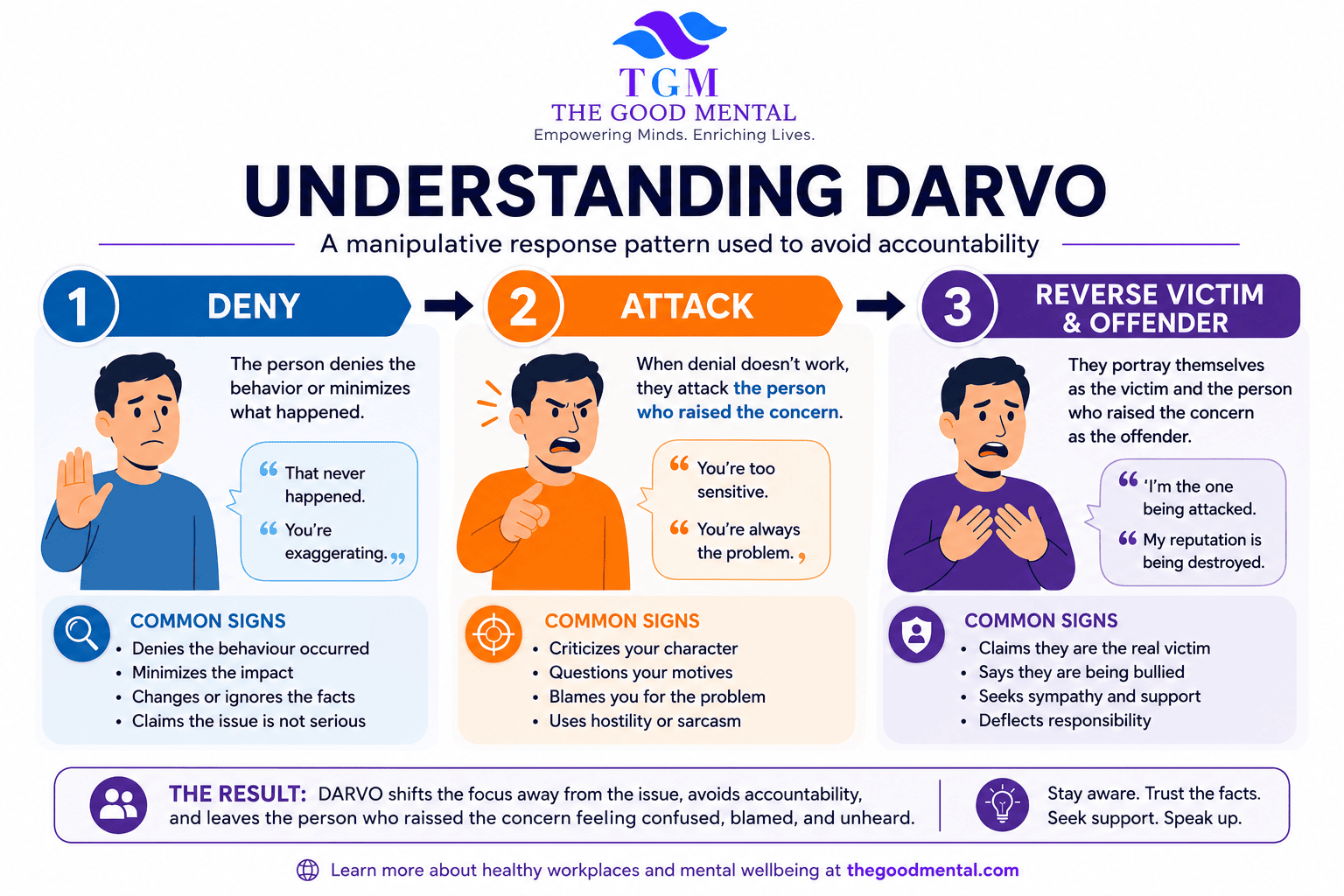
Step 2: Attack
When denial alone does not end the conversation, attention often shifts toward criticizing the person who raised the concern.
The attack may focus on:
- credibility
- competence
- motives
- emotional stability
- work performance
- personality
- relationships with colleagues
Examples include:
- “You’re impossible to work with.”
- “You always create drama.”
- “This is why nobody wants to work on your projects.”
- “You’re just trying to damage my reputation.”
These attacks may be subtle or highly aggressive, but they share a common purpose: undermine the complainant rather than address the issue.
Step 3: Reverse Victim and Offender
Finally, the accused person portrays themselves as the real victim.
Statements might include:
- “I’m being bullied.”
- “People are attacking me.”
- “I’ve worked here for years, and now my reputation is being destroyed.”
- “I’m the one who’s suffering because of these accusations.”
At this point, the original concern may receive far less attention than the emotional response of the accused.
Instead of asking:
“Did the reported behaviour occur?”
people begin asking:
“Why would someone accuse them?”
or
“Maybe both sides are equally responsible.”
The conversation shifts from examining behaviour to protecting reputations.
Why DARVO Happens in Workplaces
Not everyone who becomes defensive is using DARVO.
Receiving criticism, especially unexpected criticism, can be uncomfortable. Many people initially deny mistakes or become emotional before reflecting more thoughtfully.
DARVO differs because it follows a pattern designed – consciously or unconsciously – to avoid accountability by changing the narrative.
Several workplace factors can make DARVO more likely.
Fear of Consequences
Employees and leaders alike may worry about:
- disciplinary action
- losing authority
- damaged professional reputation
- legal consequences
- reduced career opportunities
- loss of influence
When these fears become overwhelming, protecting one’s image may feel more important than addressing the underlying concern.
Power Dynamics
DARVO often becomes more influential when significant power differences exist.
Examples include:
- executive and employee
- manager and direct report
- senior clinician and junior practitioner
- professor and student
- supervisor and apprentice
- board member and staff member
People with greater organizational influence may have stronger relationships, more credibility, and greater access to decision-makers, making it easier for their version of events to dominate.
This does not mean leaders always engage in DARVO. Rather, power can amplify its effects when it does occur.
Organizational Culture
Some workplace cultures unintentionally create conditions where DARVO flourishes.
Warning signs include:
- discouraging disagreement
- rewarding unquestioning loyalty
- protecting high performers regardless of behaviour
- treating complaints as personal attacks
- prioritizing reputation over fairness
- failing to investigate concerns consistently
In these environments, employees may conclude that speaking up carries greater risk than remaining silent.
Cognitive Biases
Human psychology also plays a role.
People naturally prefer simple explanations over complex ones. If an experienced, respected employee confidently denies wrongdoing while portraying themselves as unfairly targeted, observers may find that explanation easier to accept than a more complicated investigation.
Biases such as the halo effect, confirmation bias, and status bias can unintentionally reinforce DARVO, especially when organizations rely on assumptions rather than evidence.
How DARVO Appears in Everyday Workplace Situations
DARVO is rarely announced openly. It often unfolds gradually through conversations, emails, meetings, or investigations.
Understanding common scenarios helps employees and leaders recognize the pattern earlier.
During Performance Feedback
A manager provides constructive feedback regarding inappropriate behaviour during team meetings.
Instead of reflecting on the feedback, the employee responds:
- “You’re always criticizing me.”
- “You never appreciate my work.”
- “Everyone else interrupts meetings too.”
- “You’re singling me out.”
The discussion shifts from behaviour improvement to questioning the manager’s motives.
During Bullying Complaints
An employee reports repeated public humiliation by a colleague.
The accused immediately responds:
- “They’re trying to destroy my career.”
- “I’ve been nothing but supportive.”
- “They’re the real bully.”
- “They’re creating conflict because they’re jealous.”
The investigation becomes increasingly focused on competing personal narratives rather than examining evidence.
During Harassment Investigations
When allegations of inappropriate comments arise, the accused may insist:
- “People can’t joke anymore.”
- “This is political correctness.”
- “They’re deliberately misinterpreting everything.”
- “I’m the one being discriminated against.”
Again, accountability becomes secondary to defending identity.
During Organizational Change
Major restructuring often increases stress and uncertainty.
Suppose a leader receives feedback that communication has been inconsistent.
Rather than acknowledging concerns, they argue:
- “Everyone is attacking leadership.”
- “Employees simply don’t like change.”
- “People are spreading negativity.”
- “Management has become the victim of constant criticism.”
The original discussion about communication quality disappears.
Healthy Disagreement Is Not DARVO
One of the biggest misconceptions is assuming that every disagreement reflects DARVO.
Healthy workplaces depend on open discussion.
Employees should feel comfortable saying:
- “I remember the situation differently.”
- “Can we review the facts?”
- “I don’t believe I intended harm.”
- “I’d like to explain my perspective.”
These responses invite dialogue.
DARVO, by contrast, redirects attention away from examining the behaviour itself.
A healthy response asks:
“What happened, and how can we understand it?”
A DARVO response asks:
“Why are you attacking me?”
That distinction matters.
Organizations should avoid using DARVO as a label to dismiss disagreement. Instead, leaders should look for consistent behavioural patterns over time, supported by evidence, context, and fair investigation.
Early Warning Signs That Leaders Often Miss
DARVO rarely begins with dramatic accusations. More often, it emerges through subtle communication patterns that gradually reshape the conversation.
Leaders who recognize these early warning signs are better equipped to intervene before conflict escalates.
Watch for situations where the discussion repeatedly shifts away from facts and toward personal attacks or emotional narratives.
Examples include:
- Every concern is dismissed without consideration.
- Feedback is immediately reframed as persecution.
- The complainant’s motives become the primary topic.
- Witnesses are pressured to take sides.
- Accountability conversations repeatedly become debates about fairness to the accused.
- Emotional reactions overshadow objective evidence.
- Investigations become focused on personalities instead of behaviours.
Individually, these behaviours may not indicate DARVO. Together, particularly when they follow a complaint or request for accountability, they deserve careful attention.
Recognizing the pattern early allows organizations to respond thoughtfully, fairly, and consistently before trust begins to erode.
Wrap-up: Understanding DARVO Is the First Step
DARVO can be difficult to recognize because it often unfolds during emotionally charged conversations. What begins as a legitimate concern about behaviour can quickly shift into a discussion about the motives, credibility, or character of the person who raised it. When that happens, the original issue risks being overshadowed, making it harder for individuals and organizations to address concerns fairly and objectively.
Recognizing this response pattern is not about assigning blame or assuming wrongdoing. Instead, it equips employees, leaders, and HR professionals with a framework for identifying when conversations move away from evidence and accountability toward defensiveness and role reversal. Understanding the pattern is the first step toward fostering more respectful, transparent, and psychologically safe workplaces.
However, recognizing DARVO is only part of the picture. How it influences leadership, workplace investigations, remote teams, and organizational culture is equally important—and often more complex.
References:
Freyd, J. J. (1997). Violations of power, adaptive blindness, and betrayal trauma theory. Feminism & Psychology, 7(1), 22–32.
Freyd, J. J. (n.d.). DARVO: Deny, Attack, and Reverse Victim and Offender. Center for Institutional Courage. https://dynamic.uoregon.edu/jjf/defineDARVO.html
Edmondson, A. C. (1999). Psychological Safety and Learning Behavior in Work Teams. Administrative Science Quarterly, 44(2), 350–383.
Edmondson, A. C. (2019). The Fearless Organization: Creating Psychological Safety in the Workplace for Learning, Innovation, and Growth. Wiley.
Center for Institutional Courage. Institutional Courage and Institutional Betrayal. https://www.institutionalcourage.org/